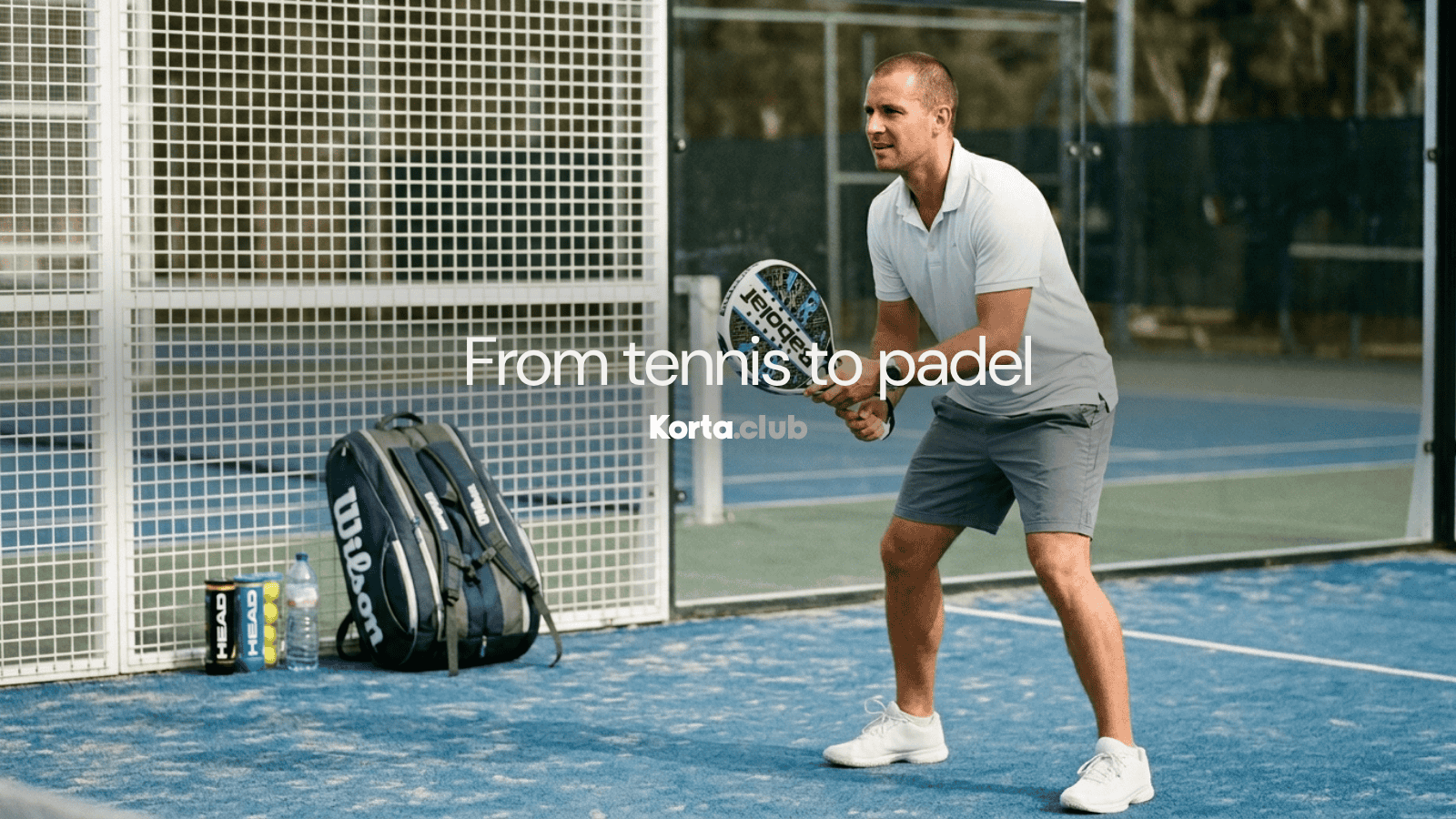
You’ve watched padel courts fill up at your local sports complex while the tennis courts next door sit half-empty. A friend mentioned it. A colleague won’t stop talking about it. You finally looked it up and thought: I already play tennis — how different can it be?
The answer is: different enough that you need a guide, but similar enough that you’ll feel at home within one session.
This guide is specifically for tennis players making the switch. We’ll skip the basics that don’t apply to you and focus on what actually changes, what transfers from tennis, and what you’ll need to actively unlearn.
What transfers from tennis (more than you think)
Before getting into what’s different, here’s the good news: you’re already ahead.
Split steps, lateral movement, recovering to the centre — all of it transfers directly. The court is smaller, so your tennis footwork is more than enough to cover it.
Net play is central to padel, and your tennis volleys work almost unchanged. If anything, your net game is one of your biggest early advantages over players who came from zero racket sport background.
Padel uses identical scoring to tennis: 15-30-40, deuce, sets, tiebreaks. You don’t need to learn anything here.
Years of reading topspin, slice, and pace on a tennis court give you an immediate edge judging the ball in padel — including how it comes off walls.
Understanding court positioning, attacking short balls, and defending lobs are all concepts you already have. Padel adds walls and doubles dynamics on top — it doesn’t replace your tennis IQ.
If you’ve played tennis doubles, you already know how to talk to a partner, cover the middle, and poach. Padel is always doubles — this experience is genuinely valuable from session one.
The result: tennis players typically reach a playable padel level in 2–3 sessions rather than the 5–10 it takes someone with no racket sport background. You’re not starting from zero.
What’s actually different
Here’s the complete comparison, tennis player to padel court:
| Aspect | Tennis | Padel |
|---|---|---|
| Court size | 23.77m × 10.97m (singles) | 20m × 10m (always doubles) |
| Walls | None — ball out = point over | Glass + mesh walls in play after bounce |
| Serve | Overhead, can jump, powerful | Underhand, bounce then hit, below waist |
| Format | Singles or doubles | Always 2v2 |
| Racket | Strung, 27”, one-piece | Solid foam core, perforated, shorter |
| Winning strategy | Power + placement, can win baseline | Placement + angles + wall use, net dominates |
| Scoring | 15-30-40-game-set-match | Identical |
| Where points are won | Baseline, net, big serve | Net position + wall combinations |
The three changes that require the most active adjustment: the serve, the walls, and the philosophy around power.
The serve: your biggest immediate adjustment
If you do one thing before your first padel session: accept that the padel serve is completely different from tennis, and that it takes a few sessions to feel natural.
The padel serve rules:
- Bounce the ball on the ground first, then strike it
- Contact must be at or below waist height — no overhead motion
- Serve diagonally into the opponent’s service box (same as tennis)
- At least one foot on the ground at contact — no jumping
- Two attempts, just like tennis
Tennis players almost universally fault on their first few serves by instinctively loading an overhead motion. Your body has muscle memory for a big serve swing — override it consciously until the new pattern feels automatic.
What a good padel serve looks like: Bounce the ball, let it rise to a comfortable height below your waist, and strike it with a short, controlled swing. You’re aiming for low bounce and diagonal placement, not pace. A flat, low serve that forces a defensive return is more valuable in padel than a powerful one that comes back off the back wall as a perfect setup for your opponents.
The serve matters less in padel than in tennis. The receiving team returns serve with the advantage of walls behind them — the server cannot dominate a rally from the serve the way a tennis player can. Focus on consistent placement, not power.
Grip and technique: what to adjust
Grip
Most tennis players use a semi-western forehand grip. In padel, this works for groundstrokes but creates friction when you’re moving continuously through volleys, wall shots, and overheads in the same rally.
The padel-native grip — learn to use this
The continental grip (the one you use for tennis serve and volleys) is the most versatile grip in padel. It handles volleys, wall play, and the padel serve without grip changes mid-rally. Most advanced padel players use a continental or close to it for most shots.
Works fine for groundstrokes
The eastern forehand grip is comfortable for groundstrokes and easier to transition to from tennis. You may need to adjust slightly for volleys and overheads, but it’s a reasonable starting point.
Your tennis default — adjust away from this
Semi-western works for baseline groundstrokes but makes volleys awkward and walls even harder. Tennis players who stay in their semi-western comfort zone often plateau early in padel because they can’t transition quickly enough in multi-shot rallies.
Swing length
This is the most common technical mistake tennis players make: swinging too big.
In padel, the court is smaller, the ball moves faster off walls, and there’s rarely time or space for a full tennis swing. Compact strokes — short backswing, controlled follow-through — are more effective and give you more recovery time.
Think of padel groundstrokes as halfway between your tennis groundstroke and your tennis volley. The ball should be controlled, not hit hard.
The backhand
Tennis players with a one-handed backhand often struggle initially in padel because the compact court and wall rebounds require quick adjustment. If you have a strong two-handed backhand, it transitions more smoothly.
The padel-specific backhand skill to develop early: the chiquita — a low, compact cross-court backhand used to pass opponents at the net when you’re under pressure in the back court. It’s essentially a controlled slice backhand with a very short swing. Your tennis slice backhand is good preparation for this.
Wall play: the genuinely new skill
This is the largest learning curve for tennis players, and the most important one to embrace early.
Walls in padel are not a hazard — they’re a strategic asset. Every shot that forces opponents to play off the back wall is a good shot. Every rally you win by using wall angles against opponents at the net is padel at its best.
The instinct that works against you first:
When a ball is heading to the back wall, a tennis player’s instinct is to cut it off before it gets there. In padel, the correct response is the opposite: let the ball hit the wall, step back to give it space, and play it as it comes off the rebound toward you.
The wall rebound rule of thumb
Position yourself behind where the ball will land off the wall — not alongside the wall. The ball comes to you off the rebound. You don’t chase it into the corner. This is the single biggest mental shift tennis players need to make, and it takes deliberate practice to override the instinct.
The three wall situations to understand:
Back wall rebound (glass)
The most common wall play situation. Ball bounces on the floor, hits the glass back wall, rebounds forward. Let it come. Position behind the expected landing zone and play it forward back into the court. Glass rebounds are predictable and fast.
Side wall (mesh above glass)
Side walls behave differently from back walls. The lower glass section rebounds fast and predictably. The metal mesh above absorbs pace — the ball dies more than you expect. Takes more sessions to read consistently.
Corner (back wall + side wall)
Two-wall shots are the hardest to read and the most valuable offensive weapon at higher levels. Don’t worry about generating these deliberately until you’re comfortable with single-wall rebounds. Focus first on defending them without panic.
Padel doubles: different from tennis doubles
You’ve played tennis doubles. The court positioning concepts translate — but padel doubles has specific tactical principles that differ from tennis.
Net position is everything
In tennis doubles, the baseline is a viable position. In padel, the team that controls the net controls the point. The goal of almost every shot from the back court is either:
- To work your way to the net, or
- To force opponents away from the net so you can take it
Staying at the baseline is defensive. Padel is won at the net.
The lob is your primary weapon from the back court
In tennis, lobs are usually a desperation shot. In padel, the lob is a tactical choice — the main tool for breaking opponents’ net dominance and forcing them back. A well-placed lob over opponents at the net followed by taking the net yourself is the standard pattern for winning back the advantage.
Tennis player adjustment: Stop treating the lob as a last resort. In padel, the lob is a first choice. You’ll use it multiple times per point, intentionally, to move opponents off the net. Start practising controlled lobs to specific depth targets from your very first sessions.
Partner positioning stays tighter
Tennis doubles pairs often split the court with one player at baseline and one at net. In padel, partners stay roughly at the same depth — both at baseline or both at net. Splitting your positions leaves too much of the court exposed on a smaller court with walls in play.
The smash is high-risk
In tennis, a smash from the net is usually a winner. In padel, a hard smash at the back wall often results in the ball rebounding back into play as a perfect opportunity for your opponents. Hard smashes without control are a gift.
Padel overheads require precision, not just power. The bandeja (a controlled overhead with slice that keeps the ball low after the bounce) and the vibora (a more aggressive version with sidespin) are the padel-specific overhead techniques to learn once your basic game is established.
How your NTRP maps to padel levels
Most padel platforms use a 1.0–7.0 scale. Here’s how your tennis rating translates as a starting point:
Basic groundstrokes transfer. Walls and serve require active learning.
Good footwork and volleying give you an immediate edge. Wall reads are the main gap.
Strong net game and tactical awareness accelerate progression. Reach consistent 4.0 padel in 6–12 months.
Athletic ability and court IQ are transferable assets. Wall mastery and padel-specific overheads are the ceiling to push through.
Why you’ll rate lower in padel than tennis
Don’t be discouraged when you find yourself rated well below your tennis level in your first padel sessions. Wall play and the padel-specific serve are genuinely new physical skills — not just knowledge adjustments. Your padel rating will climb faster than someone starting from zero, but it starts lower than your tennis rating because wall play accounts for a large portion of the game.
The habits to actively unlearn
These are the specific tennis behaviours that hurt tennis players in padel. Knowing them in advance helps you catch yourself.
1. Swinging hard from the baseline
The back walls return pace. A powerful baseline drive in padel often bounces off the back wall as a chest-high ball in the centre of the court — exactly what your opponents want. Hit with control and placement. Pace is a risk, not an asset.
2. Avoiding the lob
Tennis players treat the lob as a last resort. In padel, it’s a primary tactical shot. Use it deliberately and often to break net pressure.
3. Cutting off the ball before it reaches the wall
Resisting the instinct to intercept a ball heading to the back wall is the hardest adjustment. Step back. Let the wall do the work. Play the rebound.
4. Loading up an overhead serve
Your muscle memory wants to toss the ball and swing up. The padel serve goes the other direction: bounce, let it rise below your waist, swing short and controlled. Fault rate on the serve drops dramatically once you stop fighting this instinct.
5. Playing singles positioning
You’re always playing doubles in padel. Don’t drift into singleton coverage patterns — stay with your partner at roughly the same depth and communicate on every middle ball.
Your first sessions: a practical plan
Session 1–2: Accept the learning curve
Focus exclusively on: the serve (underhand consistency), wall rebounds (let the ball come to you), and keeping your swing compact. Don’t try to win — try to build the new muscle memory. Borrow or rent a racket before buying.
Session 3–5: Build the lob and net game
Your volleys are already an asset. Spend time practising lobs deliberately — you need depth control, not just height. Start thinking about net position: are you and your partner moving forward together when you have the opportunity?
Session 6–10: Start reading walls offensively
By now the basic rebound patterns are starting to feel intuitive. Begin playing shots designed to use walls against opponents — angled shots to the side wall, lobs designed to bounce and hit the back wall awkwardly. This is where padel starts to feel like a completely different, deeply satisfying game.
Getting your padel rating and finding partners
The sooner you have a padel rating, the faster you’ll find compatible games. Playing with people far below your level is dull; playing with people far above it is frustrating — and in padel, mismatched sessions also slow down your development because you’re not in competitive rallies.
Not sure where you sit on the padel rating scale? The Korta padel rating guide walks through the 1.0–7.0 system and has a self-assessment to help you place yourself accurately.
Finding four people for a padel session consistently is the biggest practical challenge when you’re new to the sport. Our complete guide to finding a padel partner covers this in depth. The short version:
Matchmaking platforms
Platforms like Korta match you with padel players at your level. You can find three others to build a consistent group, or slot into existing sessions looking for a fourth player.
Your tennis network
Padel is growing fastest among tennis players. Chances are several people in your tennis group are either already playing or curious. Organise a first group session — most tennis players who try padel come back.
Club drop-in sessions
Most padel clubs run open sessions where players show up and get matched into groups. Specify your tennis background when signing up — most clubs appreciate that you’ll progress faster than a complete beginner and will match you accordingly.
Next steps
You’re a tennis player. Padel is going to feel familiar and strange at the same time for the first few sessions — that’s normal, and it resolves quickly.
The biggest investment you need to make isn’t time or money. It’s accepting that your tennis habits don’t all transfer, and committing to rebuilding specific patterns from the ground up: the serve, the wall reads, and the philosophy around pace.
Once those click, your tennis background becomes a genuine advantage.
- Get your padel rating — use the Korta padel rating guide to self-assess before your first session
- Read the full padel beginner guide if you want a deeper breakdown of rules and shots — Padel for Beginners
- Find padel partners at your level — Korta matches you by skill level so your first sessions are competitive, not one-sided. See the complete guide to finding a padel partner for all seven methods
The padel community is growing fast, and tennis players are the largest group fuelling that growth. You’re already half a padel player — now finish the job.
Frequently Asked Questions
Is padel easier to learn if you already play tennis?
Yes and no. Your footwork, court sense, volleys, and scoring knowledge all transfer immediately — you'll feel comfortable within minutes. But certain tennis habits actively work against you in padel: the overhead swing, hitting hard from the baseline, and chasing the ball to the back wall instead of letting the wall play to you. Tennis players typically progress faster than true beginners, but they also have more specific habits to unlearn.
How does my tennis NTRP level translate to padel?
Roughly: NTRP 2.5 ≈ padel 1.5–2.0, NTRP 3.0–3.5 ≈ padel 2.5–3.0, NTRP 4.0 ≈ padel 3.0–3.5, NTRP 4.5+ ≈ padel 3.5–4.0. Tennis players almost always rate lower in padel than in tennis when they start — the wall play, serve technique, and short-court positioning are genuinely new skills that take time to build.
Can I use the same grip in padel as tennis?
You can start with your tennis forehand grip, but most tennis players need to adjust. The continental grip (used for tennis serves and volleys) is actually the most versatile grip in padel, since you play volleys, walls, and overheads continuously in the same rally. Players coming from a semi-western forehand grip often find the adjustment to a more continental position takes a few sessions but pays off quickly.
Do I need to buy new equipment to try padel?
Yes — padel uses a completely different racket. You cannot use a tennis racket on a padel court. The padel racket is solid (no strings), shorter, and perforated with holes. Most clubs rent rackets for $5–10 a session, so you don't need to buy anything to try it. If you decide to play regularly, a beginner padel racket costs $50–150.
How long does it take a tennis player to become competitive at padel?
Most tennis players can have genuinely competitive recreational matches within 5–10 sessions. Footwork and reflexes transfer well, and once you understand wall play and the serve, the game clicks fast. Reaching a consistent intermediate padel level (where you're playing tactical doubles with intentional wall use) typically takes 3–6 months of regular play.
Ready to find your perfect tennis partner?
Join thousands of players using Korta to find matches at their skill level.
Start Matching