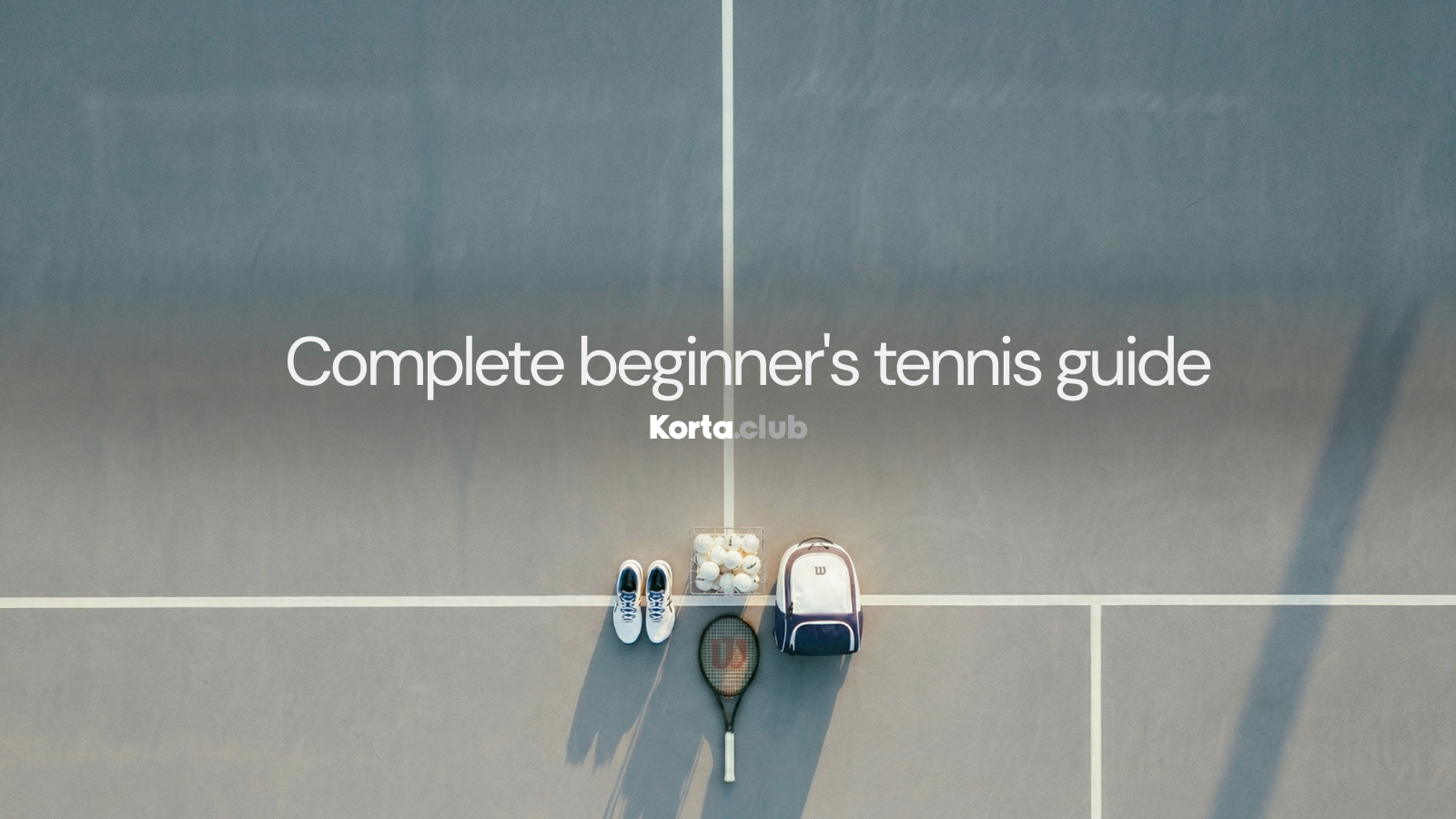
You’ve watched matches on TV, maybe caught some Australian Open highlights, and thought “that looks fun.” Your friends play on weekends and won’t shut up about it. Or maybe you just want a sport that doesn’t require assembling a full team every time you want to exercise.
Whatever brought you here, you’re in the right spot. Tennis is having a massive moment - participation hit record highs for the fifth straight year, with over 23 million Americans playing regularly. And despite what you might think, you don’t need to have started as a kid to get good at it.
This beginner tennis guide covers everything you need to know to start playing tennis: what gear to buy, how the rules work, which strokes to learn first, and where you’ll play your first match.
Why learn tennis? (And why now?)
Before we dive into the how-to, let’s talk about why tennis is worth your time - especially if you’re starting as an adult.
Research shows tennis can add almost 10 years to your lifespan - more than almost any other sport. You’re getting a full-body workout: sprinting, lunging, swinging, quick direction changes. Cardio and strength training rolled into one.
Unlike running solo or lifting alone at the gym, tennis requires a partner. You’ll meet people, build friendships, maybe even find a regular doubles group that grabs drinks after matches.
Start at any age and play for decades. Your local club probably has players in their 70s who can still beat younger opponents. Tennis is genuinely a “lifetime sport.”
Once you learn the basics, you can play in most cities. Public courts are everywhere. Hotels often have courts. Traveling for work? Throw a racket in your bag and you’ve got a built-in activity.
The catch? You need someone to play with. That’s historically been the hardest part of learning tennis as an adult - finding consistent partners at your level. We’ll solve that problem later in this guide.
What tennis equipment do beginners actually need?
Let’s talk gear. The good news? You don’t need much to start playing tennis. The even better news? You don’t need to break the bank.
1. A beginner tennis racket
This is your biggest purchase, but don’t overthink it.
For beginners, look for: Lightweight (under 10 ounces strung), larger head size (100-115 square inches for a bigger “sweet spot”), and pre-strung (saves you the hassle of getting it strung separately).
Expect to spend $30-100 for a solid beginner racket. Wilson, Head, Babolat, and Prince all make excellent entry-level options. Don’t fall for the trap of buying a $300 “pro” racket - it won’t make you better and might actually be harder to use.
Grip size matters. When you hold the racket naturally, your thumb should just touch the knuckle below your middle fingertip. Big gap? Too large. Too tight? Too small.
Most sporting goods stores let you demo rackets. Take advantage of this - what feels good in your hand might not match what the internet says is “best.”
2. Tennis balls
You’ll need a few cans. Tennis balls come in two types:
- Regular Duty (softer felt, for clay courts)
- Extra Duty (thicker felt, for hard courts)
Most public courts are hard courts, so grab Extra Duty balls. Expect to pay $3-5 per can of three balls.
Pro tip
Tennis balls go “dead” after a few weeks of regular use - they lose bounce and become harder to hit cleanly. Fresh balls make a noticeable difference in how the game feels.
3. Tennis shoes (non-negotiable)
Do not wear running shoes on a tennis court.
Running shoes are built for forward motion. Tennis requires constant side-to-side movement, quick stops, and explosive direction changes. Running shoes don’t have the lateral support you need - you’re asking for a rolled ankle.
Reinforced sides
Tennis shoes have reinforced sides specifically designed for lateral movement and quick direction changes.
Non-marking soles
Black-soled shoes leave marks on courts and will get you kicked off some facilities. Tennis shoes have proper non-marking soles.
Court-specific traction
For beginners playing on hard courts - which is most public courts - look for “all-court” tennis shoes.
Expect to spend $60-100 for a decent pair. ASICS, Nike, Adidas, and New Balance all make reliable options.
4. Athletic clothing
You don’t need fancy tennis whites or designer gear. Any athletic clothing that lets you move freely works fine.
What works:
- Moisture-wicking shirts (cotton gets heavy when sweaty)
- Athletic shorts or skorts with pockets (you need somewhere to stash a second ball when serving)
- Sports socks with extra padding at the heel and ball of foot
Optional but useful: Hat or visor, sunglasses, wristbands.
Total startup cost for beginner tennis equipment
| Item | Cost Range |
|---|---|
| Beginner racket | $50-100 |
| Tennis balls (3-4 cans) | $15-20 |
| Tennis shoes | $60-100 |
| Athletic clothing | $30-50 |
| Total | $155-270 |
Not cheap, but not outrageous either - especially for a sport you can play for decades.
Tennis rules for beginners: Understanding the court and scoring
Before you step on a court, let’s cover the basics so you’re not completely lost. Tennis rules seem confusing at first, but they click quickly once you start playing.
Court layout
A tennis court is 78 feet long. For singles (one person per side), it’s 27 feet wide. For doubles (two per side), it’s 36 feet wide.
The court is divided by a net that’s 3 feet high at the center. On each side, you’ve got:
- Baseline – the back line where you stand to serve
- Service line – 21 feet from the net
- Service boxes – the two boxes where serves must land
- Sidelines – the boundaries on either side
Most public courts are hard courts (concrete or asphalt). Some clubs have clay or grass courts, but those are less common.
Tennis scoring (yes, it’s weird at first)
Tennis scoring seems bizarre until you understand the pattern:
Instead of 1, 2, 3, tennis uses: 0 = “love”, 1 point = 15, 2 points = 30, 3 points = 40, 4 points = game (if you’re ahead by 2)
If both players reach 40-40, it’s called “deuce.” From deuce, you need to win two points in a row to win the game.
Win at least 6 games to win a set, but you must win by 2 games. If it reaches 6-6, you play a tiebreak (first to 7 points, win by 2).
Most recreational matches are best-of-three sets. Win two sets, win the match.
Confused? That’s normal. Play a few points and it’ll click. Most beginners just play “first to 10 points” when starting out anyway.
Essential tennis strokes for beginners
Tennis has six basic strokes, but as a beginner learning tennis, focus on mastering three: the forehand, backhand, and serve. These will get you through your first matches.
1. The forehand
This is the stroke you’ll hit most often - probably 60-70% of your shots. It’s also the easier groundstroke for most beginners to learn.
Basic forehand technique
- Stand sideways to the net
- Take the racket back as the ball approaches
- Swing forward, making contact in front of your body
- Follow through across your body toward your opposite shoulder
The forehand is all about rhythm and timing. Don’t try to crush the ball - focus on making clean contact and getting it over the net consistently. Power comes later.
2. The backhand
The backhand is hit on your non-dominant side. You can hit it one-handed or two-handed - most beginners find the two-handed backhand easier because it offers more control and stability.
Both hands on the grip. Turn sideways. Swing from low to high for topspin. Follow through over your opposite shoulder. Easier to learn, more forgiving on mishits.
Looks elegant (think Roger Federer), but it’s harder to learn and less forgiving. Save this for later once you’ve mastered the basics.
3. The serve
The serve starts every point, so it’s crucial. It’s also the most technically complex stroke - don’t expect to master it immediately.
Stand behind the baseline, sideways to the net
Hold the ball in your non-racket hand
Toss the ball up consistently to the same spot every time
Swing your racket up and make contact at the highest point you can reach
Aim for the diagonally opposite service box
You get two tries per point. Miss both (a “double fault”) and your opponent wins the point. Start simple: focus on getting the ball in consistently before worrying about power or spin.
4. The volley (bonus stroke)
Volleys are shots hit before the ball bounces - usually when you’re at the net. They require quick reactions and a shorter punch-like motion rather than a full swing.
You don’t need volleys for baseline rallies, but they’re useful for doubles and approaching the net in singles.
Where to play tennis as a beginner
You’ve got the gear and know the basics. Now where do you actually play?
Public tennis courts
Most cities have public tennis courts in parks - and they’re often free or very cheap. This is where most beginners start playing tennis.
How to find them:
- Google “tennis courts near me”
- Check your city’s parks and recreation website
Some public courts are first-come, first-served. Others require a permit ($50-200 per year) or allow online reservations ($10-15 per hour).
- Free or very cheap
- No membership required
- Usually well-maintained in most cities
- Can be crowded evenings and weekends
- May need to wait for an open court
- No guarantee you’ll find someone to play with
Tennis clubs
Tennis clubs offer better facilities - professional instruction, organized leagues, social events, and nicer courts. They also make finding partners easier since everyone there is, by definition, a tennis player.
Typical club membership costs
$500-2,000 per year depending on location and facility quality, plus potential initiation fees.
- Well-maintained courts
- Lessons and clinics available
- Built-in community of players
- Indoor courts at some clubs (year-round play)
- Expensive upfront and ongoing
- May have initiation fees
- Can feel exclusive or intimidating for beginners
If you’re serious about learning tennis quickly, a club membership is worth considering. Many offer trial memberships or guest passes - try before you commit.
The real challenge: finding someone to play with
Here’s the thing nobody tells you when you start learning tennis: having courts nearby doesn’t matter if you can’t find a partner.
This is the biggest frustration for adult beginners. You’ve got your gear, you know a court, but you show up and… it’s empty. Or full of players way above your level who aren’t interested in hitting with someone just learning.
There’s a better way.
Korta is built specifically for this problem. It’s a matchmaking platform for tennis players - create a profile, set your skill level and location, and connect with other players nearby who are looking for the same thing.
Skill-based matching – Find players actually at your level, not just whoever happens to be at the court
Location filtering – See players within your preferred distance, from 1km to 100km
Direct messaging – Match with someone and schedule a game immediately
It’s free to use and takes about 3 minutes to set up. Especially useful for beginners who don’t yet have a network of regular hitting partners.
Free to use. Match with players this week.
How to practice tennis and actually improve
You’ve got your gear, found a court, maybe even connected with a hitting partner. Now what?
Option 1: Take tennis lessons
This is the single best investment for fast improvement when learning tennis.
| Lesson Type | Cost | Best For |
|---|---|---|
| Private lessons | $50-100/hour | Fastest improvement, personalized feedback |
| Group lessons | $20-40/person | More affordable, meet other beginners |
| Clinics | $15-30 | Focused on specific skills (serves, volleys, etc.) |
Even just 4-6 private lessons for beginners to learn proper technique will save you months of frustration trying to figure it out yourself - and prevent bad habits that are hard to unlearn later.
Option 2: Practice with a friend
If lessons aren’t in the budget, grab a friend and hit together. You’ll both improve faster than practicing alone.
Simple practice drills for beginners
- Short court rallies: Stand inside the service boxes and hit back and forth. Builds control and feel.
- Crosscourt rallies: Hit only to each other’s forehand or backhand. Aim for 10-20 consecutive shots.
- Target practice: Set up cones or towels and try to hit them. Great for developing placement.
The key is consistency over power. Your goal early on is just keeping the ball in play - not hitting winners.
Option 3: Ball machine
Ball machines are perfect for solo practice. They feed balls at consistent speed and placement, letting you groove your strokes without chasing errant shots from a beginner partner.
Most clubs and some public facilities rent them for $10-20 per hour.
Common beginner tennis mistakes (and how to avoid them)
Every beginner makes these mistakes. The difference between players who improve quickly and those who plateau is recognizing and fixing them early.
Death grip on the racket
Beginners often hold the racket like they’re trying to strangle it. This kills wrist mobility and makes every shot feel forced.
Fix: Loosen your grip. On a scale of 1-10, you want about a 4. Learn proper grips early - Eastern or Semi-Western for forehands, Continental for serves.
Looking up too early
You’d think this is obvious, but beginners constantly look up to see where their shot is going before they’ve actually hit the ball.
Fix: Watch the ball all the way to your racket strings. Keep your head down through contact. Your eyes should still be focused on where the ball was even after it’s gone.
Lazy footwork
Standing flat-footed or shuffling slowly to the ball destroys your ability to hit quality shots. Tennis is 80% footwork.
Fix: Stay on your toes. Do a “split step” (small hop) right before your opponent hits. Move your feet continuously - small adjustments make huge differences.
Trying to kill every ball
Beginners think tennis is about power. Hit it as hard as you can, right? Wrong. Tennis is about consistency and placement - especially when you’re learning.
Fix: Start slow. Focus on getting 10 balls in a row over the net and inside the lines. Power comes naturally once your technique is solid.
Wrong equipment
Using a racket that’s too heavy, wrong grip size, or wearing running shoes instead of tennis shoes will sabotage your improvement.
Fix: Get properly fitted equipment from the start. Visit a tennis shop and ask questions - good staff will help you find the right setup.
Avoiding serve practice
The serve is the hardest stroke to learn, so beginners avoid practicing it. Big mistake - you serve on 50% of all points.
Fix: Spend 10-15 minutes every session just practicing serves. Consistency first, power later. A reliable second serve beats a wild first serve.
No game plan
Beginners just hit the ball back and hope for the best. No strategy, no targets, no intention behind their shots.
Fix: Start simple: aim deep (near the baseline) and hit to your opponent’s weaker side (usually backhand). Don’t go for winners - let them make mistakes.
Realistic timeline: How long does it take to learn tennis?
Let’s be honest: tennis is hard to learn.
You’re coordinating hand-eye coordination, footwork, timing, power, spin, and strategy - all while a ball is flying at you. It takes time and consistent practice.
That said, here’s what most beginners can realistically expect:
Everything feels foreign. The racket is heavy, the ball doesn’t go where you want, you’re missing more than you’re hitting. This is completely normal for every beginner.
Goal: Learn the basic strokes. Hit 5-10 balls in a row over the net.
You can rally with another beginner. Your forehands and backhands are becoming consistent. Your serve goes in at least half the time.
Goal: Play full games without feeling completely lost. Win some points against other beginners.
You’re rallying confidently, playing real matches, maybe joining a beginner league. Still plenty of mistakes, but you’re having fun and improving noticeably.
Goal: Reach NTRP 2.5-3.0 level. Play competitive social matches. Not sure about your level? Check your tennis rating.
You’re a legit tennis player. You can hold your own in club matches, you’re developing strategy, you can hit different spins and shot types.
Goal: NTRP 3.5-4.0. Play league matches, maybe enter local tournaments.
What speeds up (or slows down) your tennis progress
- Taking lessons from a qualified pro
- Practicing 2-3 times per week consistently
- Playing actual matches, not just drilling
- Prior experience in racket sports (badminton, squash, pickleball)
- Starting in decent physical shape
- Sporadic practice (once every few weeks)
- Only hitting with players way above or below your level
- Learning bad technique early that you have to unlearn
- Never getting professional feedback
- Not having consistent hitting partners
The bottom line: With regular practice (2-3 times per week) and some professional instruction, most people can become competent recreational tennis players within a year.
Ready to start playing tennis?
Tennis isn’t easy. It’ll be frustrating at first - balls flying everywhere, racket feeling heavy, legs burning after five minutes of running around. That’s all part of learning.
But here’s what makes it worth it: tennis is one of the few sports you can truly play for life. Start at 25, 35, or 45, and you can still be playing strong at 75. You’ll meet people, stay in ridiculously good shape, and have a lifetime hobby that’s challenging, social, and endlessly rewarding.
The hardest part isn’t learning the strokes or understanding the rules - it’s finding people to play with consistently. Solve that problem and everything else follows.
Create a profile on Korta to find hitting partners. Order a beginner racket if you don’t have one.
Connect with 3-5 players at your level on Korta. Find a local court using Google Maps. Schedule your first hit.
Play 4-6 sessions. Book a lesson or two to learn proper technique. Build a roster of 2-3 regular hitting partners.
Takes 3 minutes to set up. You could be playing this weekend.
Frequently Asked Questions
Can I learn tennis on my own without lessons?
Technically yes, but it'll take longer and you'll likely develop bad habits that are hard to fix later. Even 4-6 lessons to learn proper technique will save you months of frustration. Think of lessons as an investment - they pay off in faster improvement and fewer injuries.
What's a good age to start playing tennis?
Any age works. Kids can start as young as 4-5 with junior programs. Adults can pick up tennis at 30, 40, 50, or beyond and still become solid recreational players. Tennis is genuinely a lifetime sport - you can play well into your 70s and 80s.
How often should beginners practice tennis?
Aim for 2-3 sessions per week, about 1-2 hours each. This gives you enough repetition to build muscle memory without burning out. Consistency beats intensity - practicing twice a week for six months works better than five times a week for two weeks before quitting.
Do I need to be fit to start playing tennis?
Not at all - tennis will get you in shape. That said, it's physically demanding with lots of running, stopping, and explosive movements. If you're starting from zero fitness, take it slow and build up gradually. Your cardiovascular system adapts quickly.
How do I find people to play tennis with as a beginner?
Post in local Facebook groups, ask at public courts, or use platforms like Korta that match you with tennis partners at your skill level. Finding consistent hitting partners is the biggest challenge for beginners - once you solve that, everything else gets easier.
Ready to find your perfect tennis partner?
Join thousands of players using Korta to find matches at their skill level.
Start Matching